Graphene-based materials are among most promising for implementing novel optoelectronic devices by means of direct lithography. Changing of a laser power we can produce both the direct lithography process and reduction of the GO layer.
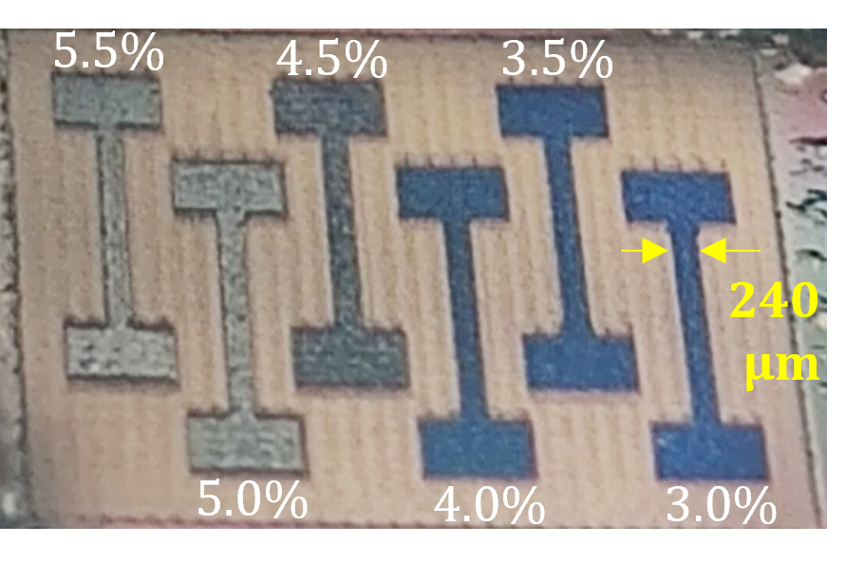
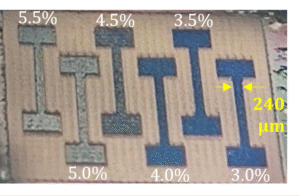
Optical image of fabricated dumbbell-shaped microstructures based on laser-reduced graphene oxide (l=455 nm, 5 mm/sec, direct mode, 10 μm step):
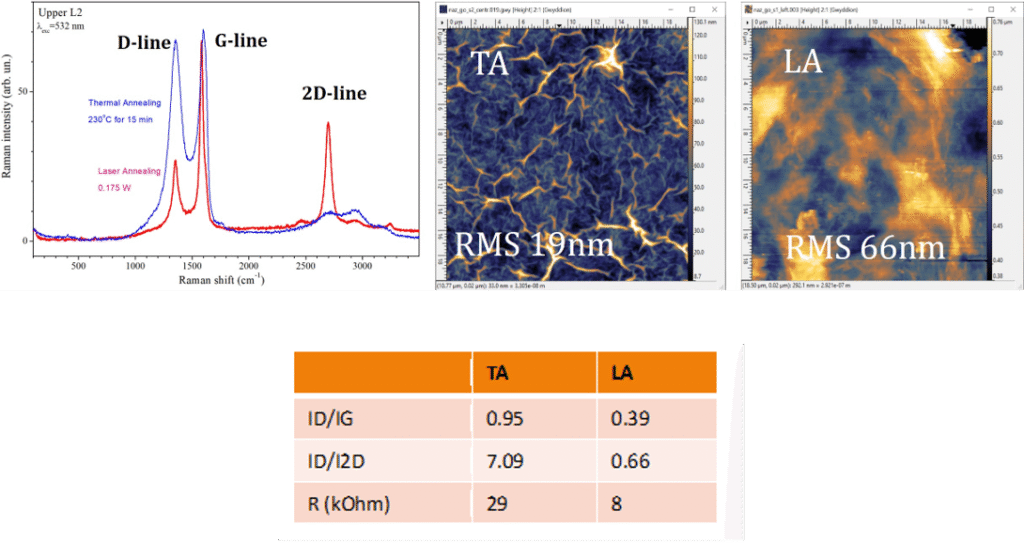
Comparison of the efficiency of graphene formation with thermal annealing
Laser reduction (LA) of graphene oxide (GO) is significantly more efficient than thermal annealing (TA). The surface of laser-reduced GO is rougher than in the case of TA (see Fig.), but is an advantage in the case of sensor applications. The main method for measuring the degree of GO reduction in our studies was Roman spectroscopy (see Fig.). In particular, the ratio of the intensities of the so-called D G and 2D bands (see Table) has a direct relation to the percentage of reduced graphene oxide in the sample.